
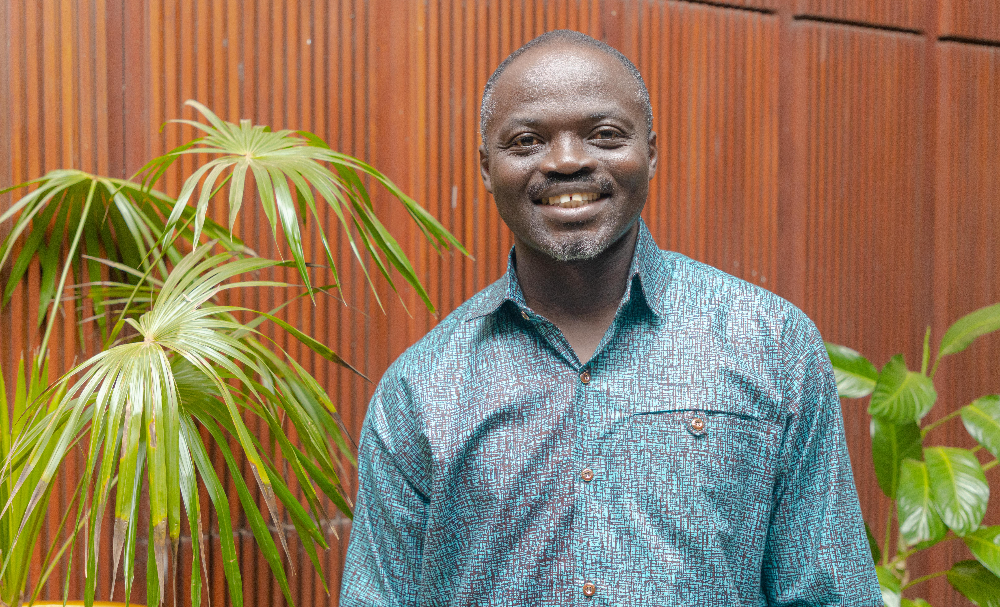
In the 2000s, radio listeners across Kumasi were often caught off guard by a confident, white-sounding caller who phoned in with disarming politeness and absurdly funny questions.
The character was called Barry Sanders, a fictional persona whose prank calls became a cult hit on local radio.
The voice behind the ruse was James Kwasi Oberko, also known as Jamestar, then a young broadcaster at Luv FM.
Two decades later, Oberko’s stage has shifted from radio studios to university offices. Yet the instincts that powered Barry Sanders: curiosity, systems thinking and a feel for people remain central to his work.
Reinventing radio
In 2009, Oberko left Luv FM to help rebrand Solid FM into K FM 103.7. As Programmes Manager, he assembled and led a results-driven on-air and off-air team, producing content that pushed the station into the top tier of listenership in the Ashanti Region.
Colleagues from the period recall a manager who combined creative risk with tight operational discipline, a broadcaster who thought like an administrator.
Turning toward academia
That instinct drew Oberko into university administration. In 2013, he was appointed Assistant Registrar at Kwame Nkrumah University of Science and Technology (KNUST), Kumasi working within the Registrar’s Office.
His early portfolio covered General Operations and Human Resources, before expanding to Academic Affairs at the KNUST Africa Institute of Sanitation and Waste Management in Accra. By August 2017, he had been transferred to the Publications and Documentation Unit of the University Relations Office.
A year later, he was promoted to Senior Assistant Registrar and placed in charge of Media and Events, a role that would define his institutional legacy.
Building systems
At the time, the University Relations Office largely revolved around two units: Publications and Documentation, and Alumni Relations. News production, however, had become central to KNUST’s public presence.
Oberko responded with a policy paper proposing a specialised Media and Events Section. Approved in 2018, the reform made him the first head of the new unit. Under his leadership, the section professionalised coverage of university activities and oversaw major projects, including the production of KNUST’s 70th Anniversary documentary.
He also led the physical redevelopment of parts of the University Relations Office, transforming the university’s intercom room into functional, modern office spaces.
The alumni turn
In 2020, Oberko was transferred to the Advancement and Alumni Relations Office (AARO). The move proved anything but routine.
He led the Office and spearheaded the redesign of what is now regarded as one of the most visually distinctive administrative spaces on campus, featuring the Alumni Wall of Fame, an idea later replicated across the University’s faculties and colleges.
Yet even there, he found room for ideas that extended beyond walls and furniture.
Oberko is the initiator of the Nyansapo Dialogue Series, now in its fourth year. The platform brings students and alumni into conversation, drawing on personal stories and lived experience to help younger students understand campus life, career pathways, and institutional culture.
The series has featured personalities such as Zapp Mallet, Nikki Samonas, Rt. Rev. Prof. Osei Safo-Kantanka, and Mr. Kwame Saarah Mensah.
For many participants, the sessions offer something not found in handbooks or orientation manuals: perspective.
“I really enjoyed the conversations. It gave me renewed hope,” said Alice, a first-year engineering student.
Oberko also initiated the KNUST Day of Giving and established the Tek Connect platform, which now connects more than 16,000 alumni.
Still rolling
Oberko’s red Peugeot 406 Sedan, ageing but stubbornly reliable has carried him between offices, and meetings, much like the initiatives he is known for: modest in appearance, persistent in motion.
From prank calls that poked fun at people to reforms that reshaped institutional structures, James Kwasi Oberko’s career traces an unusual but coherent arc: one where humour, structure and human connection are never far apart.
By: Emmanuel Kwasi Debrah


